
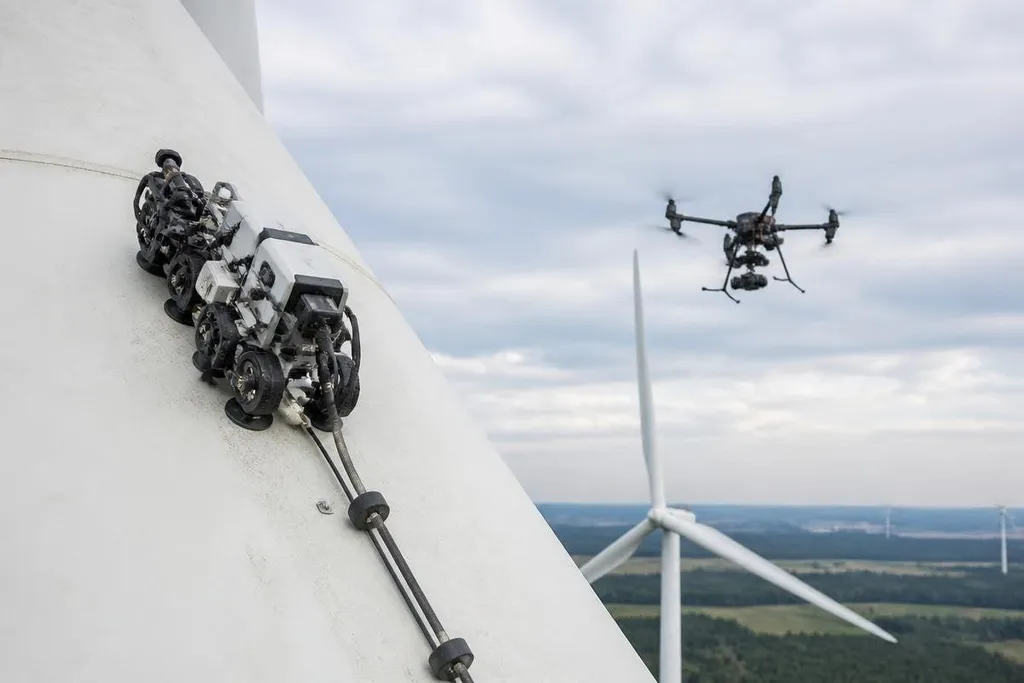
A wind turbine robot may inspect a blade, check a tower wall, or carry a camera into a space a technician cannot reach safely. The next stage is harder: showing that the robot can find a real fault, explain it clearly, and help fix it.
- Blade robots can inspect composite surfaces for cracks, erosion, and lightning damage.
- Drones can cover large areas, but wind, glare, and image quality still affect results.
- Repair work remains less proven than inspection.
Inspection comes first
Wind turbines give robots a clear job. Their blades are long, exposed, and difficult to inspect by hand. A robot can move along a blade while cameras record the surface, or a drone can circle the rotor and collect images from several angles.
Those images may show leading-edge erosion, loose material, surface cracks, or marks from lightning. The useful result is not a large image folder. It is a clear record of where the fault sits, how large it looks, and whether it needs a visit from a technician.
A blade-crawling robot faces a different problem from a flying drone. It must hold to a curved composite surface while the blade moves, and its wheels or tracks must avoid damaging the coating.
A drone avoids contact, but wind can move it away from the planned view.
The best system for a wind farm may be a mix of both. A drone can scan many turbines, then a contact robot can inspect one damaged area in more detail. That cuts down the number of climbs, while keeping a human in charge of the repair decision.
The hard part is reading the evidence
Image collection is only one step. An inspection system also needs to separate a real crack from dirt, shadow, water, or a mark in the paint. That becomes harder when blades are wet, the sun is low, or the camera angle changes between visits.
A useful robot must attach each finding to the turbine, blade, and position on that blade. It should also keep the original image, the inspection date, and the level of confidence in its result. Without that record, a technician still has to repeat the whole check.
For a wind farm manager, those records matter when a report says a robot found blade damage. Wind turbine robotics reports can tie the result to the robot, blade position, test date, and weather before the next section asks whether a clean trial holds up in salt, rain, and dust.
The open issue is proof. A maker may show a robot finding a marked defect in a clean test. That does not show how well it handles salt, rain, dust, faded coatings, or faults that were not known in advance.
Repairs will decide the next stage
Inspection robots can work without carrying heavy tools. Repair robots cannot. They may need to remove damaged coating, apply new material, or hold a tool against a curved blade while the wind changes the load.
That work needs careful force control. Too little pressure leaves a poor repair. Too much pressure can damage the blade surface. The robot also needs a safe way to stop if its grip weakens or its position estimate becomes unreliable.
Remote control may remain part of the process for a long time. A technician could guide the robot through an unusual repair, then let its software repeat the same motion across similar areas. That approach keeps human judgment in the loop while reducing time spent at height.
I'd fund inspection systems before repair systems, because finding a defect is a narrower task with a clearer result.
A practical buying check
Before a wind farm operator signs a trial agreement, check these points:
- Surface contact: confirm how the robot stays on the blade and what happens when the coating is wet.
- Weather limits: record the wind, rain, temperature, and light conditions allowed during a scan.
- Evidence format: ask for original images, defect locations, inspection dates, and confidence scores.
- Human review: set out which findings need a technician to approve them.
- Repair boundary: state whether the robot only marks faults or also carries tools and material.
- Failure recovery: test how it stops, returns, or gets removed after a power or communication loss.
These checks turn a polished demonstration into a work test. They also show where the robot saves a visit and where it only adds another layer of software.
Wind turbine robots will earn wider use when operators can compare their findings with technician inspections over repeated seasons. Until makers publish that record, the safest bet is targeted inspection, with repair work still waiting for stronger field proof.